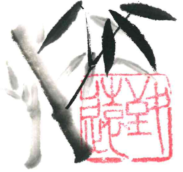
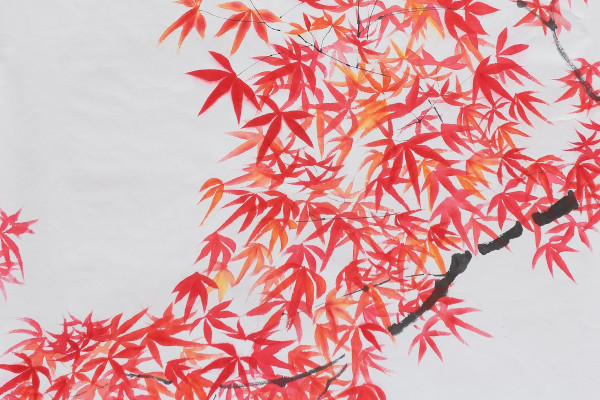
An in-person Sumi-e workshop allows you to learn Japanese ink painting by seeing first-hand how the brush is prepared, how pressure changes during each stroke, and how ink, water and paper interact.
It is not simply a matter of sitting down and copying an image. In a Sumi-e session, simple movements and individual elements are usually practised first and then progressively applied to bamboo, flowers, branches, landscapes and other motifs.
For someone who has never tried this technique before, a workshop can be summarised in the following steps:
- Become familiar with the materials.
- Learn how to hold and move the brush.
- Practise pressure, direction and speed.
- Discover how ink changes when mixed with water.
- Work on some basic brushstrokes.
- Apply them to a simple motif.
- Arrange several elements on the paper.
- Observe and correct the gesture with the guidance of the teacher.
The main difference compared with practising only from an image or video is that in an in-person workshop you can observe the complete gesture and receive corrections while you are painting.
If you would like to check upcoming dates and available formats, you can explore Kaoru Hirose’s in-person Sumi-e workshops and Japanese ink painting courses.
What is a Sumi-e workshop?
A Sumi-e workshop is a practical learning session dedicated to Japanese ink painting.
The brush, ink, water and paper are the main elements, but learning Sumi-e involves much more than simply becoming familiar with the materials.
During practice, we need to pay attention to:
- posture;
- how we hold the brush;
- the amount of water;
- the concentration of the ink;
- pressure;
- speed;
- direction;
- continuity of the gesture;
- the relationship between brushstrokes;
- the space we leave unpainted.
In Sumi-e, a small change in any of these elements can completely transform a brushstroke.
For this reason, a workshop is not simply about explaining a technique and then leaving each participant to paint on their own.
Demonstration, practice and observation are all part of the same learning process.
If you have never practised this discipline before, it may also be useful to discover what to learn first in Sumi-e before creating complex compositions so you can understand the usual progression of the learning process.
Do I need to know how to paint before attending a Sumi-e workshop?
You do not need previous drawing or painting experience to start learning the fundamentals of Sumi-e.
In fact, at the beginning there is no need to create a complex finished work.
We can start by practising:
- lines;
- dots;
- curves;
- changes in pressure;
- fast and slow movements;
- different shades of ink;
- small leaves;
- stems;
- petals.
The initial objective is to understand how the brush responds.
Someone who is used to drawing with a pencil may even need to change some habits. A brush loaded with ink does not behave in the same way: it opens with pressure, changes thickness as it moves, and leaves a mark on the paper that is affected by water, speed and gesture.
That is why, if this is your first experience, it is particularly useful to work from the foundations.
In the guide Sumi-e for beginners: how to train your hand and stroke, you can learn more about how posture, the wrist, the arm and breathing affect a brushstroke.
How does an in-person Sumi-e workshop begin?
Before painting a complete composition, it is useful to become familiar with the materials and make some initial tests.
This allows us to discover something important very quickly: black is not simply one black.
The same ink can produce:
- a very intense black;
- a dark grey;
- a medium grey;
- a very light tone;
- an almost transparent wash;
- a dry texture;
- a defined edge;
- a more diffused mark.
Everything depends on how we combine ink, water, brush and paper.
One of the advantages of learning in person is being able to see exactly how much ink the brush contains, how the teacher places it on the paper and what movement she makes with her hand and arm.
These are details that can be difficult to understand by looking only at a finished image.
First learn the gesture, then the motif
One of the most important ideas for someone attending a Sumi-e workshop for the first time is understanding that we do not necessarily begin by trying to paint a complete work.
We can first practise the movement we are going to need.
For example, if we are going to paint bamboo, we can work separately on:
- The stem.
- The nodes.
- The branches.
- The leaves.
- The relationship between several elements.
Only afterwards do we bring them together.
This way of learning allows us to focus on one difficulty at a time.
If you would like to arrive at the workshop having experimented with some basic movements, you can start with these Sumi-e brush exercises for beginners, designed to develop pressure control, ink load and fluidity.
What do you learn in a Sumi-e workshop?
The content may vary according to the level, duration and chosen motif, but there are several fundamental skills that appear repeatedly in Sumi-e practice.
| Learning area | What we work on |
|---|---|
| Brush | Pressure, angle, direction and speed |
| Ink | Concentration, moisture and different shades |
| Gesture | Continuity, decisiveness and coordination |
| Observation | Identifying essential forms |
| Motifs | Leaves, branches, flowers, bamboo, landscapes… |
| Composition | Balance, rhythm and negative space |
These elements do not work independently.
For example, a leaf depends on the gesture, but also on the amount of ink held by the brush. A branch depends on direction, but also on the rhythm it establishes in relation to other forms.
Learning gradually involves coordinating all these decisions.
The brush: learning pressure, direction and speed
One of the first discoveries in a Sumi-e workshop is how many possibilities a single brush can offer.
We can use:
- only the tip;
- part of the bristles;
- almost the entire body of the brush;
- the side of the brush;
- a very wet brush;
- an almost dry brush.
If we increase the pressure, the stroke becomes wider.
If we reduce the pressure while moving, we can finish with a fine point.
If we move the brush quickly, the ink may leave a different mark from the one created when moving it slowly.
The advantage of in-person learning is that the teacher can observe how we are making the movement, not just the final result.
For example, she can identify whether we are gripping the brush too tightly, blocking the wrist or interrupting a gesture that should be continuous.
Ink and water: discovering different intensities
Another fundamental part of the learning process is controlling the relationship between ink and water.
We can prepare several shades and compare how the same movement changes.
A simple exercise consists of creating a series of brushstrokes:
Concentrated ink → dark grey → medium grey → light grey → highly diluted ink.
We do not need to change the shape.
We only change the concentration.
This allows us to see how tone changes the visual weight of an element.
Later, these differences will help us create depth, contrast and hierarchy within a composition.
Observe before painting
In a workshop, we do not only learn which movement to make.
We also learn what to observe before making it.
Suppose we want to paint a branch.
We can ask ourselves:
- Where does it begin?
- Which direction does it grow in?
- When does it change direction?
- Which part carries the most visual weight?
- Which branches are the main ones?
- Which details could we remove?
Sumi-e does not necessarily aim to reproduce all the information we can see.
We have to decide which characteristics are sufficient to express the motif.
This ability to simplify develops through practice.
Traditional motifs you can work on in Sumi-e
Natural subjects appear very frequently because they allow us to practise very different types of movement.
These include:
- bamboo;
- orchid;
- plum blossom;
- chrysanthemum;
- flowers;
- pine trees;
- birds;
- rocks;
- mountains;
- water;
- landscapes.
Each motif presents a different challenge.
Bamboo helps us practise control, rhythm and direction. Orchid introduces long, curved movements. Plum blossom allows us to combine stronger strokes with delicate flowers. Chrysanthemum develops repetition and organisation.
You can explore this subject in greater depth in the guide to classic Sumi-e motifs and what you learn from each one.
Bamboo as an exercise for a beginner Sumi-e workshop
Bamboo is particularly interesting because it can easily be divided into several different exercises.
Stems
They allow us to work on verticality, stability and pressure.
Nodes
They introduce interruptions and small changes within the structure.
Branches
They require us to change direction while maintaining continuity.
Leaves
They require quicker and more decisive gestures.
When the individual elements begin to work separately, we can bring them together within a small composition.
If you would like to become familiar with the process beforehand, you can follow the guide on how to paint bamboo in Sumi-e step by step.
Painting flowers in a Sumi-e workshop
Flowers allow us to work with a different type of sensitivity.
A petal can be created with a single gesture if we know how to combine pressure, movement and the lifting of the brush.
We do not need to draw the outline first and then fill it in.
We can practise:
- individual petals;
- small groups of petals;
- stems;
- leaves;
- branches;
- different concentrations of ink.
Then we begin to relate the forms to one another.
This introduces an important idea: we do not need to represent every petal for a flower to be understood.
Learning how to select what is essential is part of the technique.
In how to paint flowers in Sumi-e: basic strokes and composition, you can find a specific introduction to these movements.
From an exercise to a small composition
Once we have some control over individual elements, we can begin to relate them to one another.
For example:
one branch + three leaves
or:
one flower + stem + two leaves
At this point, we are no longer thinking only about the quality of each brushstroke.
We also need to decide:
- where to place the main element;
- how much space to leave around it;
- which direction it will follow;
- which area will contain the darkest ink;
- which forms will be secondary;
- when we should stop adding elements.
Composition introduces another way of observing.
We no longer look only at what we are painting.
We also look at the space we leave empty.
If you would like to explore this aspect before or after the workshop, you can read more about how to balance negative space, ink and movement in a Sumi-e composition.
What are the advantages of learning Sumi-e in person?
An online class and an in-person workshop can teach the same fundamental principles, but the experience is not exactly the same.
In an in-person workshop, we can observe closely:
- the angle of the brush;
- the position of the hand;
- the pressure being applied;
- how the brush is loaded with ink;
- how much moisture the brush contains;
- the speed of the movement;
- the order of the brushstrokes.
The teacher can also observe our posture and gesture while we are painting.
This makes it possible to give very specific corrections.
For example:
Try lifting the brush a little more.
You are using too much water here.
Make this movement more continuously.
Do not add another leaf yet.
The correction is not simply about saying whether the painting is right or wrong.
It helps us understand which decision produced that result.
What materials are used in a Sumi-e workshop?
The main materials are relatively simple:
- brushes;
- ink;
- water;
- absorbent paper;
- containers for preparing different shades;
- felt or protection for the working surface;
- a cloth.
Depending on the workshop, materials may be provided at the venue or participants may be asked to bring certain items. It is always advisable to check the specific conditions of the session before attending.
The International Sumi-e Association in Tokyo, for example, offers an official Sumi-e workshop programme in which participants are introduced to brush use and painting techniques through practical instruction.
How to prepare before your first Sumi-e workshop
There is no need to study for weeks before attending.
However, becoming familiar with a few concepts can help you make the most of the experience.
Do not try to learn everything beforehand
The purpose of the workshop is precisely to practise.
You do not need to master pressure, ink or composition in advance.
Arrive with curiosity, not with the obligation to create a perfect work
The first brushstrokes are exercises.
Some will work better than others.
All of them provide information.
Observe complete demonstrations
Do not look only at the finished image.
Pay attention to:
- how the brush is loaded;
- where the movement begins;
- how the pressure changes;
- what the hand is doing;
- when the brush is lifted.
Ask about the gesture, not only the result
Instead of asking:
Why is my leaf wrong?
it may be more useful to ask:
What should I change in the pressure or movement to achieve this type of leaf?
The second question helps us understand the technique.
What should you do after a Sumi-e workshop?
A single experience can be enough to discover the technique, but the movements need repetition before they become more natural.
After the workshop, we can dedicate short sessions to repeating what we have learned.
There is no need to practise every day.
We can choose:
Day 1: repeat lines and changes in pressure.
Day 2: work on one part of the motif learned during the workshop.
Day 3: combine several elements.
Day 4: try a small composition.
To organise this continuity, you can use the guide on how to establish a Sumi-e practice routine at home.
And if you begin to feel that your brushstrokes are not turning out as expected, remember that learning does not mean repeating until you produce a perfect copy. In how to practise Sumi-e at home without getting frustrated, you will find a more progressive approach to continuing your practice.
In-person Sumi-e workshop or online classes: which should you choose?
There is no single learning format that is right for everyone.
It depends on how you prefer to learn.
An in-person workshop may be suitable if…
- you want to try Sumi-e for the first time;
- you want to observe the gesture directly;
- you prefer practising in a shared environment;
- you want to receive corrections in person;
- you are looking for an experience concentrated on a specific date.
Online classes may be suitable if…
- there are no Sumi-e workshops near you;
- you want to maintain a weekly practice;
- you prefer learning from home;
- you want to develop several subjects progressively;
- you need continuity over a longer period.
Kaoru also teaches live online Sumi-e classes, where each subject is developed progressively and the individual elements are practised separately before being brought together in a composition.
Both formats can complement each other.
You can attend an in-person workshop to work intensively on a particular motif and then continue practising through regular classes.
Intensive Sumi-e workshops and courses at art schools
In-person learning does not have to be limited to a short introductory class.
Sumi-e can also be explored through intensive courses, masterclasses and programmes adapted to artistic education.
Kaoru Hirose teaches Sumi-e masterclasses and courses at universities and art schools, where the technique can be integrated into broader educational programmes.
There is also the possibility of organising an intensive Sumi-e workshop in your city for schools, associations, events or groups.
These formats allow the experience to be adapted to different profiles: from people discovering Sumi-e for the first time to art students interested in exploring Japanese ink painting in greater depth.
Learning Sumi-e with a specialised teacher
In a technique where small changes in the gesture can have such a significant effect on the result, observing how the teacher works is especially important.
Kaoru Hirose was born in Tokushima, Japan, and is a Sumi-e artist and certified teacher by the International Sumi-e Association in Tokyo. Since 2013, she has taught courses, demonstrations and workshops at universities, art schools and cultural institutions in different European cities.
You can learn more about her training and professional experience in the biography of Kaoru Hirose, Sumi-e artist and teacher.
This experience is particularly relevant in a workshop because we do not only see a finished work.
We can observe how it is constructed from the very first movement.
What can you take away from your first Sumi-e experience?
The result of a workshop should not be measured only by the painting we take home.
We may also leave with a better understanding of:
- how to hold a brush;
- how it responds to pressure;
- how ink changes with water;
- why a fast brushstroke differs from a slow one;
- how to observe a motif before painting it;
- how to simplify a form;
- how to relate several elements;
- why negative space forms part of the composition;
- when it is better to stop.
These are the skills that allow us to continue practising afterwards.
A workshop can be a first experience with the technique, but it can also become the starting point for a deeper learning process.
If you would like to begin with an in-person experience, you can check the upcoming Sumi-e workshops and in-person Japanese ink painting courses with Kaoru Hirose.
Frequently asked questions about Sumi-e workshops
What is a Sumi-e workshop?
A Sumi-e workshop is a practical experience for learning Japanese ink painting. Participants work on brush handling, different ink concentrations, basic brushstrokes, observation of motifs and, depending on the level, small compositions.
Do I need to know how to draw before attending a Sumi-e workshop?
No. Beginners can start by working on lines, dots, changes in pressure, leaves and other basic movements before moving on to more complete motifs. Previous drawing experience is not essential.
What do you learn in your first Sumi-e workshop?
An introductory session can include posture, how to hold the brush, pressure, direction, speed, the relationship between ink and water, and several simple brushstrokes or motifs.
What do you paint in a Sumi-e workshop?
The content depends on each workshop. Common motifs include bamboo, flowers, orchids, plum blossom, chrysanthemums, birds, trees, mountains, water and other natural subjects.
What materials do I need for a Sumi-e workshop?
The main materials are brushes, ink, water, absorbent paper and containers for preparing different shades. Before attending, it is advisable to check whether the workshop provides the materials or whether participants need to bring anything.
Is it better to learn Sumi-e in person or online?
Both formats can be useful. An in-person workshop allows you to observe the brush movement directly and receive immediate corrections, while online classes make it possible to maintain regular practice from home.
How long does a Sumi-e workshop last?
The duration depends on the specific programme. It may be an introductory session, an intensive workshop or a course divided into several sessions. It is always advisable to check the details of the individual workshop before registering.
Can I create a complete painting in my first Sumi-e workshop?
It may be possible to create a small composition, but the initial objective should not be to produce a perfect finished work. It is more useful to understand the brush, ink and movements that will later be applied to a composition.
What is the difference between a Sumi-e workshop and a Sumi-e course?
A workshop usually focuses on a specific experience, technique or motif over a limited period. A course allows the learning process to continue over a longer period, introducing different motifs and progressively developing technique and composition.
Where can I attend an in-person Sumi-e workshop with Kaoru Hirose?
Kaoru Hirose organises and teaches in-person Japanese ink painting courses and workshops in different locations and cities. Available dates, locations and levels are published on her page dedicated to in-person Sumi-e workshops and courses.