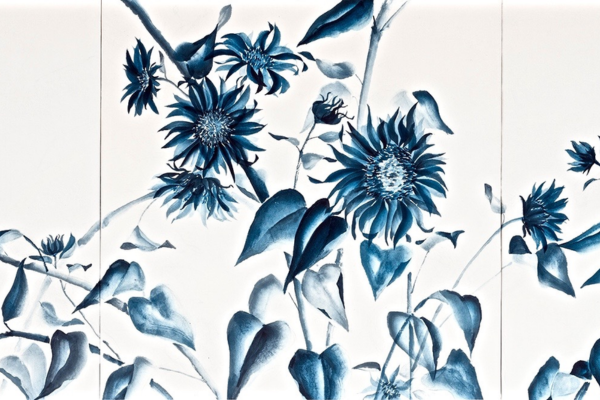
Painting flowers in Sumi-e is one of the most beautiful ways to get started in Japanese ink painting. A flower may seem like a delicate and simple subject, but in reality it requires observation, brush control, sensitivity to the ink, and the ability to simplify.
In Sumi-e, we do not seek to represent every petal literally. The important thing is to express the essence of the flower: its direction, its movement, its lightness, its energy and the balance between the full and the empty. Therefore, before attempting to paint a whole flower, it is advisable to have a good understanding of the basic strokes and how the composition is organised.
If you are just starting out with this technique, it may also help to first understand what Sumi-e is and how to learn it, as this discipline is not based solely on painting, but also on observing, breathing and working on your brushwork with care.
What you need to know before painting flowers in Sumi-e
Flowers in Sumi-e are not painted by piling on details. They are constructed with just a few strokes, but each one must have purpose. A petal, a leaf or a stem may seem simple, but every stroke reveals how the brush has been loaded, how much pressure has been applied and the rhythm with which the hand has moved.
That is why, before painting a whole flower, it is important to practise three basic aspects:
- The pressure of the brush.
- The amount of ink and water.
- The direction of the stroke.
When these three elements start to come together, the flowers no longer look stiff and begin to appear more natural. If you’re still working on your basic brush control, you can practise first with these Sumi-e brush exercises for beginners.
Basic materials for painting flowers in Sumi-e
You don’t need too many materials to start painting flowers in Sumi-e. The most important thing is that you can practise comfortably and observe how the ink reacts on the paper.
The basic materials are:
- A Sumi-e brush or oriental calligraphy brush.
- Black ink or an ink stick.
- Clean water to dilute the ink.
- Absorbent paper, preferably rice paper or paper suitable for ink.
- A dish or palette to prepare different concentrations of ink.
- Scrap paper to remove excess water or ink.
In flower painting, the ratio of ink to water is particularly important. A very concentrated ink can give strength to a stem or branch, whilst a more diluted ink can express the softness of a petal. If you’d like to explore this further, you can consult this guide on Japanese painting techniques and materials for Sumi-e.
Basic strokes for painting flowers in Sumi-e
Before painting a whole flower, it is a good idea to practise the strokes that will later form petals, leaves, stems and branches. These exercises help to train your hand and understand how the brush responds.
Drawing Petals
In Sumi-e, petals are usually rendered with a brief, controlled stroke. The brush is placed gently on the paper, pressed lightly to open out the stroke, and lifted naturally to finish with a finer tip.
This movement allows you to create a three-dimensional petal without needing to draw its outline. The key is not to go over the stroke. In Sumi-e, a stroke must retain its freshness.
To practise this, you can draw several rows of individual petals, varying the pressure and the amount of ink. Observe which ones look livelier and which ones appear too stiff.
Stroke for leaves
Leaves usually require a firmer stroke than petals. You can start by pressing the brush down more firmly, dragging it in one direction and lifting it gradually to create a natural tip.
A leaf does not have to be perfectly symmetrical. In fact, a slight irregularity can make it look more lifelike. The important thing is that the stroke has direction and does not look flat.
Stroke for stems
The stem requires continuity. It should convey structure, but without looking harsh. To practise this, draw vertical or slightly slanted lines, maintaining steady pressure and avoiding excessive brush tremor.
The stem can be painted with darker ink than the petals to provide contrast. You can also vary the thickness of the stroke to make the composition look more natural.
Drawing thin branches
Thin branches help to add movement to a floral arrangement. In this case, the brush should be moved lightly, allowing the line to ‘breathe’. It is not necessary for all the branches to be the same length or point in the same direction.
A branch that is too straight can look artificial. On the other hand, a slight curve helps to convey growth and movement.
How to paint a simple flower step by step
Once you have practised the basic strokes, you can start with a simple flower. There is no need to aim for a complex composition. The important thing is that each part makes sense within the whole.
1. Observe the general shape of the flower
Before painting, take a few seconds to observe the flower you wish to depict. Do not focus solely on the details. Look at its direction, how it opens, the weight of the petals and the relationship between the flower, stem and leaves.
In Sumi-e, observing before painting is essential. Painting doesn’t begin when the brush touches the paper, but when you decide what is essential and what you can leave out.
2. Prepare ink in various shades
For a simple flower, you can prepare three shades: dark ink, medium ink and diluted ink. The dark ink can be used for stems or details. The medium ink can be used for leaves. The lightest ink works well for delicate petals.
This variety of shades allows you to create depth without adding too many strokes.
3. Paint the main petals first
Start with the petals that define the shape of the flower. Don’t try to paint them all. Choose the most important ones so that the flower is recognisable with just a few strokes.
Work calmly, but without pausing too long in the middle of a stroke. If you hesitate, the ink will show it. It is better to make a simple, lively stroke than an overly controlled one.
4. Add the stem and leaves
Once the flower has its basic shape, add the stem with a firm stroke. Then add one or two leaves, taking care not to overcrowd the space.
Leaves can balance the composition and guide the eye. They do not need to be arranged symmetrically. In Sumi-e, balance does not always mean symmetry.
5. Leave empty space
Empty space is an essential part of the composition. There is no need to fill the entire page. A flower can appear more powerful if there is space around it.
Before adding a new stroke, ask yourself if it is really necessary. Often, the composition improves when you stop at the right moment.
Floral composition in Sumi-e: how to structure the painting
Composition is key to ensuring that a flower painted in Sumi-e does not appear as an isolated exercise. It is not just a matter of painting each stroke well, but of ensuring that all the elements come together harmoniously.
The direction of the flower
Before you begin, decide which way the flower is moving. It may grow upwards, lean to one side or open out diagonally. This direction will give unity to the whole composition.
A composition without direction can appear static. In contrast, a slightly tilted flower or a branch that gently crosses the paper can convey life and movement.
The balance between full and empty
In Sumi-e, empty space is not surplus space. It is part of the painting. An area without ink can bring calm, depth and balance.
When painting flowers, avoid filling in every gap. Let the eye rest. The composition will be more elegant if you don’t try to explain everything.
The rhythm of the brushstrokes
A flower may have soft petals, firmer leaves and more structured stems. This variety creates rhythm. If all the brushstrokes have the same intensity, the painting may appear flat.
Combine bolder strokes with lighter ones. Alternate between dark ink and diluted ink. Allow some elements to stand out more, whilst others provide a subtle backdrop.
Common mistakes when painting flowers in Sumi-e
When we start painting flowers in Sumi-e, it is normal to make mistakes. The important thing is to learn to recognise them without getting frustrated and to use them as part of the process.
Using too many strokes
One of the most common mistakes is adding more petals, more leaves or more detail than necessary. In Sumi-e, the strength often lies in synthesis. A flower can be conveyed with just a few strokes if they are well placed.
Tracing over the same stroke
Tracing over a petal or a leaf can cause the stroke to lose its freshness. If a stroke doesn’t turn out as you expected, it’s better to observe it, learn from it, and repeat the exercise on another sheet.
Always using the same ink intensity
If all the elements have the same tone, the composition can appear flat. Flowers in Sumi-e gain depth when different shades of ink are combined: darker, medium and diluted.
Painting without observing first
Painting straight away without pausing to look can make the flower appear stiff or lacking direction. Observing beforehand helps you decide which strokes are essential and which elements can be omitted.
How to practise painting flowers in Sumi-e without getting frustrated
Painting flowers requires patience. At first, the petals might not take the shape you expect, the leaves might look too stiff, or the ink might spread further than intended. All of this is part of the learning process.
To practise without getting frustrated, it is best to break the session down into small exercises:
- Practise petals on their own first.
- Then work on individual leaves.
- Then move on to stems and branches.
- Finally, combine the elements into a simple composition.
This way, you aren’t trying to tackle the whole painting at once. You learn each part separately and then integrate them with greater confidence. This guide on how to practise Sumi-e at home without getting frustrated may also help, especially if you’re starting to establish a practice routine.
Simple flowers to get started with Sumi-e
Not all flowers are equally difficult to paint. If you’re just starting out, it’s best to choose subjects that allow you to practise your brushwork without requiring too much detail.
Simple five-petalled flower
This is a good choice for practising the basic shape of the petals and circular composition. You can practise with diluted ink and add a darker centre to create contrast.
Plum Blossom
The plum blossom is a very common motif in Eastern painting. It allows you to practise small petals, fine branches and composition with empty spaces.
Orchid
The orchid requires longer, more elegant strokes. It is a good motif for practising direction, fluidity and brush movement.
Chrysanthemum
The chrysanthemum can be more complex, but it is also very interesting for working on repetition, rhythm and structure. It is best to tackle it once you have more control over petals and leaves.
When a Sumi-e class can help you
Practising on your own is useful, but a class can help you correct aspects that aren’t always apparent when practising at home. The position of the brush, the pressure applied, the amount of water, or the direction of the stroke can make a big difference to the result.
Online Sumi-e classes are a good option if you want to learn from home with clear, step-by-step guidance. They can also help you better understand the philosophy behind Japanese ink painting, not just the technical aspects.
If you want to progress with professional guidance, you can check out Kaoru Hirose’s online Sumi-e course and start working on the fundamentals of brushwork, ink and composition in a more structured way.
Conclusion: painting flowers in Sumi-e is about learning to simplify
Painting flowers in Sumi-e is not about copying every detail of a real flower. It is about observing, choosing the essential elements and expressing them with a few strokes full of intention.
The petals, leaves, stems and branches are exercises in technique, but also in sensitivity. Each stroke reveals how you relate to the brush, the ink, the paper and the empty space.
If you practise little by little, without demanding perfect results from the outset, flowers become a very beautiful way to learn Sumi-e: simple in appearance, profound in practice and full of expressive possibilities.
Frequently asked questions about painting flowers in Sumi-e
Is it difficult to paint flowers in Sumi-e?
It doesn’t have to be difficult if you start with simple flowers and practise the basic strokes first. The most important thing is to learn to control the pressure of the brush, the amount of ink and the direction of the stroke.
Which flower is best for beginners in Sumi-e?
A simple flower with few petals, a plum blossom or a branch with small flowers can be good options for beginners. They allow you to practise petals, branches and composition without too much complexity.
What strokes do I need to learn to paint flowers?
The most important strokes are the petals, leaves, stems and fine branches. It is also useful to practise changes in pressure, curved lines and different ink intensities.
Do I need to sketch the flower before painting it?
In Sumi-e, the aim is not usually to sketch out every detail before painting. It is better to observe the flower’s overall shape and then express its essence with direct, conscious strokes.
How can I make the petals look more natural?
To make the petals look more natural, it is best to vary the pressure of the brush, avoid repeating the same stroke and work with different ink intensities. It is also important not to try to make all the petals look the same.
Why do my Sumi-e flowers look stiff?
Flowers can look stiff when you paint with too much tension, when you control the brush too tightly, or when all the strokes have the same direction and intensity. Practising loose strokes and observing the flower’s movement more closely can help.
Can I learn to paint flowers in Sumi-e through online classes?
Yes, online classes can help you better understand brushwork, composition, pressure and the relationship between ink and water. They are particularly useful if you want to practise at home with clear guidance.