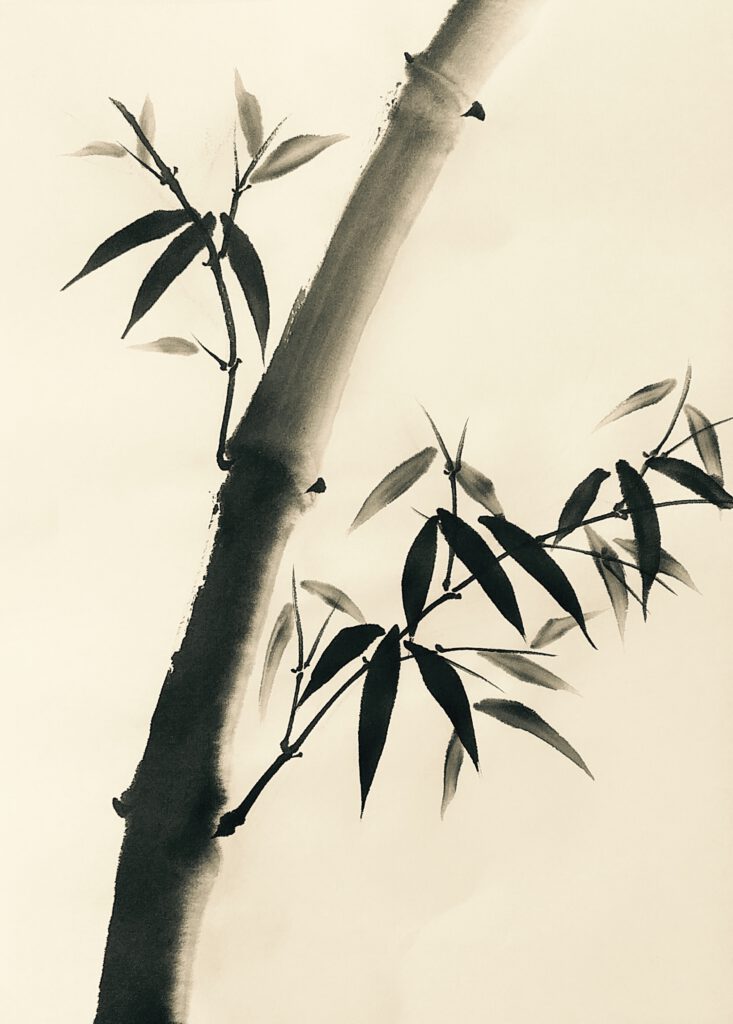
Bamboo is one of the most iconic motifs in sumi-e and, at the same time, one of the best exercises for understanding how this art form works. Although at first glance it may seem a simple shape, painting bamboo in sumi-e requires brush control, rhythm, observation and a good understanding of negative space and brushwork.
Precisely for this reason, bamboo is often one of the first subjects practised when starting out. It helps us train our hand, improve brush pressure and understand how a seemingly simple image can convey balance, movement and character. In other words, learning how to paint bamboo in sumi-e is not just about depicting a plant, but about learning to observe, simplify and paint with intention. This type of practice ties in very well with basic technical exercises and a consistent routine of brush training in sumi-e.
In this guide, we’ll look step-by-step at how to paint bamboo in sumi-e, what materials you’ll need, how its structure is built up, what mistakes to avoid, and how to practise to really improve.
Why bamboo is so important in sumi-e
In sumi-e, bamboo is not just any old motif. It has been used for centuries as a learning exercise because it requires the artist to master several technical fundamentals at the same time. On the one hand, one must control the verticality of the stem. On the other, one must render the nodes with decisiveness. Furthermore, the leaves require the artist to manage direction, speed, pressure and lightness.
This makes bamboo an excellent training subject for beginners, but also a motif to which experienced artists return time and again. The more you practise, the more nuances emerge. The same bamboo can appear rigid, light, alive, serene or dynamic depending on how the stroke is executed.
If we truly wish to understand how to paint bamboo in sumi-e step by step, we must first accept an important fact: it is not about copying a plant photographically, but about capturing its essence through simple, well-executed strokes. In the tradition of ink painting, bamboo has also been a motif steeped in symbolism, associated with integrity, strength and flexibility. This cultural dimension can be better understood in this reference from the Metropolitan Museum on ink bamboo painting.
Materials for painting bamboo in sumi-e
Before you begin, it is advisable to prepare your materials properly. You do not need a large number of tools, but it is important to work with materials that allow you to control the ink and the brush with a degree of precision.
To paint bamboo in sumi-e, you will need:
- a sumi-e brush or ink brush with a fine tip
- black ink or an ink stick with an inkstone
- paper suitable for sumi-e or similar absorbent paper
- a stable surface to work on
- clean water and a cloth or absorbent paper
The behaviour of the paper greatly influences the result. Paper that is too absorbent can make it difficult to control the stroke, whilst paper with a better response allows you to work more effectively with variations in ink load and pressure. If you are still unsure which paper to choose, you may find it helpful to read these tips on choosing the right paper for Japanese painting.
It is also advisable to prepare ink of varying intensities. Bamboo in sumi-e benefits greatly when not everything is painted with the same black. Being able to alternate between more intense and softer tones adds depth, naturalness and visual richness.
How to observe bamboo before painting it
One of the most common mistakes when learning how to paint bamboo in sumi-e is to start painting without observing. However, before picking up the brush, it is advisable to take a close look at the plant’s structure.
Bamboo is typically organised into:
- stems segmented by nodes
- branches emerging from specific points
- elongated, delicate leaves
- a general direction of growth
- a sense of flexibility, not absolute rigidity
Although bamboo appears very straight, it actually has life and movement. It is not advisable to draw it as a series of mechanical lines. In sumi-e, even the most vertical motifs need breathing space and internal energy.
A good practice before painting is to look at various references and observe how the stems are distributed, where the leaves open, how much empty space there is between elements, and what overall rhythm the composition conveys.
How to paint bamboo in sumi-e, step by step
Step 1. Prepare the ink and brush
Start by loading the brush with enough ink to maintain a continuous line, but without excess. The key to painting bamboo lies largely in the brush responding well. If it holds too much water or too much ink, the stems may lose definition.
You can prepare two shades:
- a darker ink for stems or details
- a slightly lighter ink for leaves or secondary elements
This small change helps to give the composition more depth.
Step 2. Practise drawing the stems on a separate sheet first
Before drawing a complete bamboo plant, it’s a good idea to practise drawing the stems several times. A bamboo stem isn’t drawn with a single, unvarying line. It’s usually built up in segments, with the nodes clearly marked.
To do it properly:
- use the brush with confidence
- work on each segment consistently
- avoid tremors
- leave small visual pauses where the nodes will be
The stem should convey stability, but not artificial rigidity. You should aim for a lively verticality, not a hard, mechanical line. This aspect improves greatly when combined with specific stroke and repetition exercises, such as those practised in these brush exercises for beginners.
Step 3. Mark the bamboo nodes
The nodes are essential because they structure the plant and give it its identity. Without them, the stem loses visual credibility.
In sumi-e, nodes are usually rendered with small horizontal or slightly curved strokes, integrated into the rhythm of the stem. They should not look like decorative cuts added at the end, but rather a natural part of the structure.
Here, it is best to work with restraint. If we overdo each node, the bamboo can lose its elegance.
Step 4. Add secondary branches
Once the main stems have been drawn, add some secondary branches. These help to break up the stiffness and prepare the ground for the leaves.
The branches should not compete with the main stem. Their role is to complement the composition and create areas where the movement continues. It is therefore best if they follow a natural direction and do not appear in every spot in the same way.
Step 5. Paint the leaves with a fluid stroke
The leaves are one of the most expressive parts of bamboo in sumi-e. Here, the brush should move with greater freedom. It is no longer so much about vertical structure as it is about rhythm, direction and lightness.
To paint the leaves:
- use a quick but controlled stroke
- apply light pressure at the start and ease off at the end
- vary the direction
- group some leaves together, but leave space between them
- avoid excessive symmetry
A common mistake is to paint each leaf rigidly, as if filling in a template. In sumi-e, the leaves work best when they appear to emerge naturally.
Step 6. Check the balance of the composition
Once the bamboo is in place, it is not a good idea to keep adding elements non-stop. It is better to stop and look.
Ask yourself:
- Does the composition breathe?
- Are there any areas that are too crowded?
- Do the stems have a good rhythm?
- Do the leaves follow the overall movement?
- Is the negative space well distributed?
In sumi-e, knowing when to stop is just as important as knowing how to draw.
Common mistakes when painting bamboo in sumi-e
Learning how to paint bamboo in sumi-e step by step also involves recognising the mistakes that often occur at the beginning.
One of the most frequent mistakes is making the stems too rigid. Bamboo has structure, yes, but it also has elasticity. If the line looks like a ruler, the work loses its life.
Another common mistake is painting leaves without rhythm. When they all have the same angle, the same size and the same spacing, the image becomes flat.
It is also common to use the same ink intensity throughout the piece. This reduces depth and makes the composition more monotonous.
Finally, many people add too many leaves or too many stems for fear of leaving empty spaces. However, in sumi-e, empty space is part of the image. Many of these obstacles coincide with common mistakes when learning sumi-e, especially when trying to control every stroke too much.
How to practise bamboo in sumi-e and improve more quickly
The best way to improve is not to create complete compositions all the time, but to break your practice down into smaller parts.
You can practise as follows:
- one day just stems
- another day just nodes
- another day just leaves
- another day small compositions of two or three stems
- another day ink variations
- another day observing and copying references
This type of practice helps much more than repeating whole drawings without correcting anything. Bamboo in sumi-e requires muscle memory. The clearer you are about the movement of each part, the more natural the final result will be.
It also helps to work in short series. Instead of drawing a single bamboo and trying to make it perfect, try doing five or six quick versions. That way you’ll see better what works, what doesn’t, and how the energy of the stroke changes.
What bamboo conveys in sumi-e
Although from a practical point of view we study it as a technical exercise, bamboo also has a very strong expressive value. It is often associated with flexibility, resilience, simplicity and balance.
This fits very well with the language of sumi-e, where every stroke seeks to say a great deal with very little. That is why bamboo is not only useful for learning technique, but also for understanding the spirit of this art form.
Conclusion
Learning how to paint bamboo in sumi-e step by step is one of the best ways to get started in this discipline and, at the same time, a practice that remains useful even for experienced artists. Bamboo combines structure, rhythm, lightness and expressiveness in a single motif.
To master it, it is advisable to observe before painting, practise each element separately, control the amount of ink, and pay attention to the balance between solid and empty space. And to continue progressing with a more solid foundation, it can be very useful to combine this type of exercise with online sumi-e classes, explore in-person courses, or discover the sumi-e workshops available.
Frequently asked questions about painting bamboo in sumi-e
Is bamboo a good subject for beginners in sumi-e?
Yes, bamboo is one of the best subjects for beginners because it allows you to practise stems, nodes, leaves, rhythm and brush control all in one session.
Which part of the bamboo is the most difficult to paint in sumi-e?
It depends on the individual, but the leaves are often the most difficult as they require agility, direction and well-controlled pressure to make the stroke look natural.
Can you paint bamboo in sumi-e using just one shade of ink?
Yes, you can, but working with different intensities usually produces a richer result with greater visual depth.
How many stems should one include in a composition?
There is no single rule, but when starting out, it usually works best to work on simple compositions of two or three stems before moving on to more complex arrangements.
How can one avoid making the bamboo look stiff?
It is advisable to practise the brushwork before the final piece, avoid overly mechanical lines, and bear in mind that the plant has structure, but also flexibility and movement.
What do you learn by practising bamboo in sumi-e?
You improve your brush control, the pressure of your strokes, the balance between ink and water, the compositional rhythm, and the ability to simplify forms without losing expression.
How long does it take to improve at painting bamboo in sumi-e?
It depends not only on time, but on how you practise. Consistent practice, even if brief, usually yields better results than long but sporadic sessions.