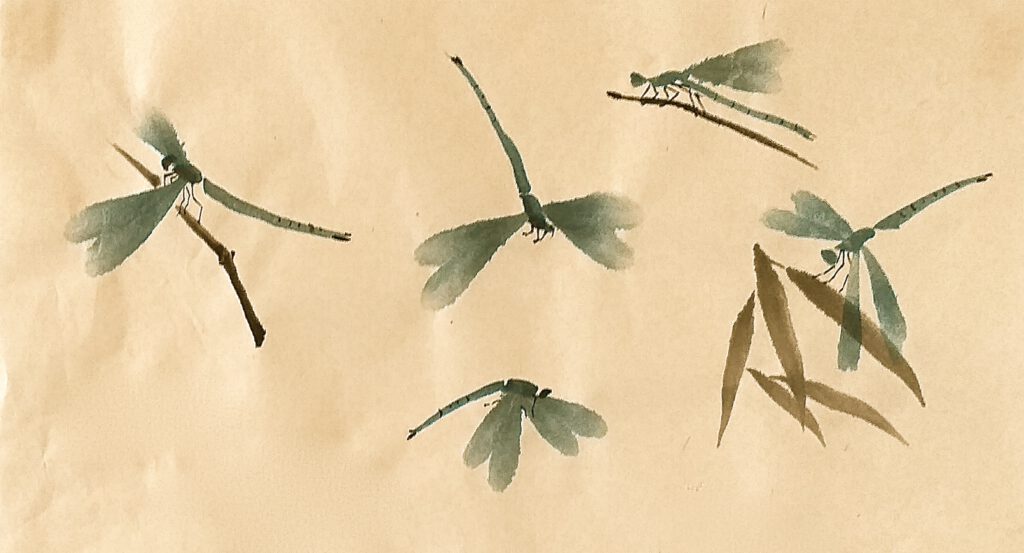
A Japanese ink painting or Sumi-e painting is a work painted by hand with sumi ink and a brush on paper, in which the gesture, the greys and the empty space are as important as the motif. When choosing one for your home, it is worth looking at five things:
- The motif: bamboo, plum blossom, flowers, birds or a more abstract composition, and what each one conveys.
- The size: in relation to the wall and the furniture around it.
- The format: a single piece, a diptych or a triptych.
- The light in the room: paper and ink are best preserved away from direct sunlight.
- The framing: a good mount protects the work and lets the white of the paper breathe.
| Criterion | What to consider |
|---|---|
| Motif | The meaning and the feeling you want in that room |
| Size | The work should look neither lost nor cramped on the wall |
| Format | Diptychs and triptychs work well on wide walls |
| Light | Indirect light is best, with no direct sunlight |
| Original or reproduction | Only an original shows the real texture of ink on paper |
In this article we look at what makes a Sumi-e painting different from other Japanese paintings, what its most common motifs mean and how to choose the right size, format and place. If you would like to see real examples as you read, you can browse Kaoru Hirose’s Japanese paintings.
What is a Sumi-e painting and how is it different from other Japanese paintings?
When we search for “Japanese paintings” we find very different styles: prints of waves and mountains, geisha prints, brightly coloured illustrations or ink paintings. Sumi-e belongs to this last group and has a character of its own.
A Sumi-e painting can be recognised by:
- ink as the protagonist: deep blacks, greys and washes, sometimes with very restrained colour;
- the visible gesture: each brushstroke is made in one go and is not corrected;
- empty space: the unpainted paper is part of the composition;
- synthesis: a bamboo stem, a branch or a bird is expressed in just a few strokes.
This means a Sumi-e work behaves differently on a wall. It does not fill the space with information: it brings calm, rhythm and a sense of air around it.
If you would like to understand the technique better, you can read what Sumi-e means and how composition in Sumi-e balances negative space, ink and movement.
Choosing the motif: what each one conveys
The motif is usually the first thing we notice. In the East Asian ink painting tradition, many motifs carry symbolic associations that can help you choose.
| Motif | Traditional association | Feeling in a space |
|---|---|---|
| Bamboo | Integrity and flexible strength: it bends without breaking | Order, verticality, serenity |
| Plum blossom | Perseverance: it blooms at the end of winter | Contrast between strength and delicacy |
| Orchid | Refinement and understated elegance | Lightness and movement |
| Chrysanthemum | Longevity and autumn | Richness of detail and rhythm |
| Pine | Endurance and longevity | Solidity and texture |
| Crane | Longevity and good fortune | Elegance and calm |
| Landscape | Connection with nature | Depth and spaciousness |
Bamboo, plum blossom, orchid and chrysanthemum make up the so-called Four Gentlemen, one of the most classic groupings in ink painting. In the article on classic Sumi-e motifs you can see what each one contributes from a technical point of view.
Beyond the symbolism, it is worth asking yourself what feeling you want in that room. A vertical bamboo conveys stability in a study or an entrance hall. A flowering plum branch brings delicacy to a bedroom. A more abstract composition with large areas of ink can be the focal point of a living room.
Choosing the size, format and place
Size in relation to the wall
A common rule of thumb in interior design is that the work should take up roughly two thirds of the width of the furniture beneath it, such as a sofa, a sideboard or a bed. In Sumi-e, empty space is also part of the work: a piece that is too large for the wall loses the air around it.
Single piece, diptych or triptych
Sumi-e lends itself very well to multi-piece formats. On the page of Kaoru Hirose’s artworks you can see, for example, diptychs of 90 x 180 cm, triptychs of 64 x 192 cm, square pieces of 64 x 64 cm, elongated formats of 60 x 30 cm and even a set of nine paintings.
| Format | Where it works best |
|---|---|
| Small or medium piece | Corners, hallways, shelves, desks |
| Square piece | Balanced walls, group arrangements |
| Elongated vertical format | Narrow walls, entrances, beside doors or windows |
| Diptych or triptych | Wide walls, above a sofa or a bed |
| Set of several pieces | Large walls that call for a composition of their own |
Diptychs and triptychs allow the motif to continue from one piece to the next, like a branch crossing the space or a bamboo stem repeated with rhythm.
Light and placement
Ink on paper is delicate. It is best hung away from direct sunlight, radiators and steamy rooms such as bathrooms or kitchens. Indirect light also makes it easier to appreciate the greys and the lightest areas of ink.
Original or reproduction
Many of the “Japanese paintings” sold in home décor shops are prints. They can be decorative, but in Sumi-e there is something a reproduction cannot capture: the real texture of ink on paper.
| Original work | Printed reproduction | |
|---|---|---|
| Ink | Visible layers, sheen and dry areas | Flat surface |
| Paper | You can see how it absorbs the ink | The texture is lost |
| Piece | Unique: no brushstroke is ever repeated | Identical copies |
| Authorship | Made by hand by the artist | Depends on the edition |
In an original Sumi-e work, each stroke was made only once. That is why, when we look at it closely, we can see the direction of the brush, the pressure and the moment the ink began to dry.
Framing and conservation
An ink work on paper needs a mount that protects it without putting it under strain: a mount board or spacer so that the paper does not touch the glass, acid-free materials and, if there is natural light, UV-filtering glass.
In the guide on how to frame and preserve an ink artwork you will find the process step by step, which glass to choose and where to hang the work so that it lasts.
A Sumi-e painting as a gift
An original Sumi-e painting is a personal gift: it is a unique piece, and the motif can be chosen with the recipient in mind. A few ideas:
- bamboo for someone starting a new chapter;
- a plum blossom branch for someone who has come through a difficult time;
- a crane or a pine as a wish for a long life;
- a small or medium piece if you do not know the space where it will hang.
If the person is interested in the technique, another option is to give them the experience of painting. Kaoru Hirose offers gift vouchers for her in-person Sumi-e courses.
Kaoru Hirose’s artworks
Kaoru Hirose was born in Tokushima, Japan, and is a Sumi-e artist and teacher certified by the International Sumi-e Association in Tokyo. Since 2013 she has taught courses, given demonstrations and held exhibitions in different European cities. You can learn about her career in her biography.
On her Japanese paintings page you can see works in different formats and motifs, from individual pieces to diptychs, triptychs and sets of several paintings. To ask about the availability of a work, you can get in touch through the contact page or by writing to info@kaoruhirose-sumie.com.
And if, after looking at her work, you feel like trying the technique, you can start with the online Sumi-e classes, which take place weekly with the teacher live.
Frequently asked questions about Japanese ink paintings
What is a Sumi-e painting?
It is a work painted by hand with sumi ink and a brush on paper. It is characterised by the visible gesture, the use of blacks and greys, the synthesis of forms and the importance of empty space.
What is the difference between a Sumi-e painting and other Japanese paintings?
Many Japanese paintings sold as décor are prints or colour reproductions. Sumi-e is ink painting made by hand, in which each brushstroke is made only once and the unpainted paper is part of the composition.
Which motif should I choose for a Japanese painting?
It depends on the feeling you are looking for. Bamboo conveys order and serenity, plum blossom combines strength and delicacy, the orchid brings lightness and landscapes give depth. You can also take their traditional symbolism into account.
What does bamboo mean in Japanese painting?
It is traditionally associated with integrity and flexible strength, because it bends without breaking. It is one of the Four Gentlemen of ink painting, together with plum blossom, the orchid and the chrysanthemum.
What size of painting should I choose?
A common guideline is for the work to take up about two thirds of the width of the furniture beneath it. In Sumi-e it is worth leaving air around it, because empty space is part of the work.
Where should I hang an ink painting on paper?
On an interior wall, with indirect light and a stable temperature. It is best to avoid direct sunlight, radiators and steamy rooms such as bathrooms and kitchens.
How is a Sumi-e work framed?
With a mount board or spacer so that the paper does not touch the glass, acid-free materials and, if there is natural light, UV-filtering glass. The mounting should be reversible so as not to damage the paper.
Is an original or a reproduction better?
A reproduction can work as decoration, but only an original shows the real texture of ink on paper. An original Sumi-e work is also a unique piece.
Where can I see Sumi-e paintings by Kaoru Hirose?
On the artworks page of her website, which shows individual pieces, diptychs and triptychs with their dimensions. To check availability, you can get in touch through the contact page.