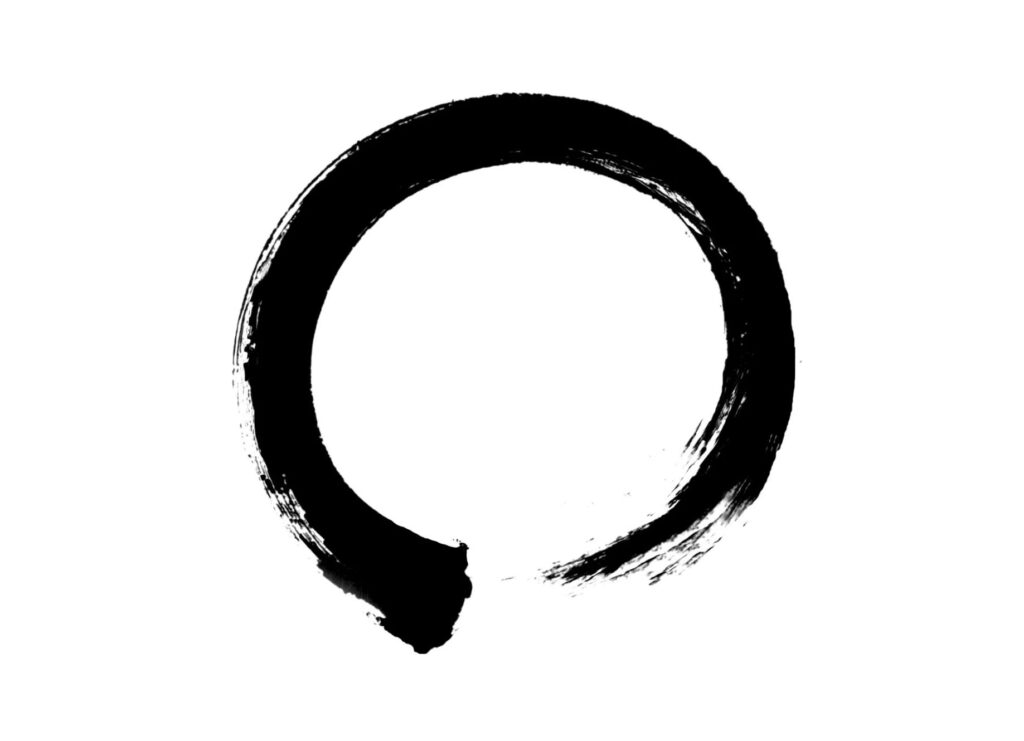
The ensō (円相) is the Zen circle: a circle painted with ink and brush in one or two strokes, without corrections. In Zen Buddhism it is associated with enlightenment, emptiness and wholeness, and it is considered a reflection of the painter’s state of mind at that moment.
To paint an ensō, we do not need to draw a perfect circle. We need to prepare the brush well and make a continuous, decisive movement:
- Prepare the ink, the paper and a well-loaded brush.
- Settle your posture and breathe before you begin.
- Place the brush on the paper and travel around the circle in a single gesture, moving the arm and not only the fingers.
- Let the pressure and the ink change along the stroke.
- Lift the brush and do not retouch.
| Aspect | What it brings to the ensō |
|---|---|
| A single stroke | Continuity and presence of the gesture |
| Ink | Intensity, moisture and dry areas |
| Open or closed form | Imperfection and movement, or completeness |
| Empty space | The inside of the circle is part of the work |
In this article we look at what the ensō means, where it comes from, the difference between the open and the closed circle, and how to practise it step by step. If this is your first contact with Japanese ink painting, it may help to read first what Sumi-e means.
What does ensō mean?
The word ensō is written in Japanese with two kanji: 円 (en), meaning circle, and 相 (sō), which can be translated as form or appearance. Literally, it would be “the form of the circle”.
In the Zen tradition, the ensō does not have a single fixed meaning. It has been interpreted in several ways:
- Enlightenment: the spiritual awakening that Zen practice seeks.
- Emptiness: the inside of the circle refers to the idea of emptiness, or mu.
- Wholeness: the universe, everything that exists contained in a simple form.
- The present moment: the circle can only be painted once, at one specific instant.
That is why it is said that an ensō shows the state of mind of the person who paints it. It matters less that the circle is regular than that the gesture is sincere and continuous.
This idea connects with the Japanese aesthetics of imperfection. If this aspect interests you, you can explore it further in the article on the aesthetic elements of Japanese painting: wabi-sabi and mono no aware.
Open ensō and closed ensō
An ensō can be left open, with a small gap between the beginning and the end of the stroke, or closed, with both ends joined. Neither is more correct than the other: each form conveys a different idea.
| Open ensō | Closed ensō | |
|---|---|---|
| Form | The stroke does not join up | The stroke completes the circle |
| Associated idea | Movement, development, the beauty of the incomplete | Completeness, perfection, wholeness |
| Aesthetic connection | Very close to wabi-sabi | Close to the idea of unity |
| When painting it | You have to decide where to stop the gesture | You have to decide how the end meets the beginning |
In practice, the difference is not decided by the form alone. It also depends on how the brush finishes: an ending that gradually dries and opens out leaves a very different feeling from an ending loaded with ink that joins the beginning with force.
Where does the ensō come from? Zen, calligraphy and ink painting
The ensō comes from the tradition of Zen Buddhism in Japan. For centuries it has been painted by Zen monks and masters, often accompanied by a calligraphic inscription, and mounted on hanging scrolls to be displayed in temples and meditation spaces.
These works are part of what is known as zenga, the painting and calligraphy associated with Zen. One example is the 18th-century ensō with calligraphy attributed to Rankeisai held by the Brooklyn Museum, painted in ink on paper and mounted as a hanging scroll.
Although the ensō is a symbol and not a written character, it is practised with the same tools and principles as Japanese calligraphy: the brush, the ink, absorbent paper and a gesture that allows no corrections. You can see this relationship in the article on Japanese painting and calligraphy and in the differences between sumi-e, suibokuga and shodō.
What does the ensō have to do with Sumi-e?
The ensō is not a Sumi-e motif in the same sense as bamboo or the orchid, but it shares the essentials with it:
- a single gesture made with decisiveness;
- control of the ink and water inside the brush;
- the importance of empty space;
- acceptance of the mark that each stroke leaves.
That is why painting ensō is also a good exercise for anyone who practises Sumi-e: it requires you to maintain the continuity of the movement throughout a long, curved stroke, something that is later applied to orchid leaves, branches or complete compositions.
Materials for painting an ensō
You do not need complex equipment to paint an ensō. The basic materials of Japanese ink painting are enough:
- Brush: a medium or large one that can hold enough ink to travel around the whole circle.
- Ink: ready-made sumi ink or an ink stick ground with water.
- Paper: absorbent paper for ink, in a format that leaves space around the circle.
- Felt: under the paper, so that the ink does not soak through to the table and the paper does not move.
- Water and a container: to adjust the load of the brush.
- A cloth: to remove excess ink.
The size of the brush and the paper shapes the gesture. A small circle can be made with the wrist; a large one requires you to move the arm and sometimes the whole body. To begin with, a medium format that allows a comfortable, complete movement is best.
How to paint an ensō step by step
Painting an ensō takes only a few seconds, but everything that happens before the stroke is just as important.
1. Prepare the space and the materials
Set out the felt, paper, ink, water and cloth before you begin. If you have to get up to look for something with a loaded brush, the gesture loses its continuity. Put distractions aside too: for those few minutes, we are only going to paint.
2. Mind your posture
Sit or stand with your back straight and your shoulders relaxed. Hold the brush without gripping it. The movement of a large circle comes from the arm and shoulder, not only from the fingers; if the hand is stiff, the stroke will show it.
3. Load the brush
The brush needs to carry enough ink to travel around the whole circle. If the load is too small, the stroke will break off too soon; if it is too heavy, the ink will spread on the paper. Remove the excess on the edge of the container and do a test on another sheet.
4. Observe and breathe
Before touching the paper, look at the blank space and decide where the circle will begin and how large it will be. A calm breath helps to separate the preparation from the gesture. This is not a special technique: it is simply a matter of not starting in a hurry.
5. Trace the circle in a single gesture
Place the brush on the paper and travel around the circle continuously, without stopping halfway. Keep a steady speed and let the brush respond: the pressure may vary and the stroke may widen or narrow.
As it moves, the brush loses ink. It is common for the end of the stroke to show dry areas where the texture of the paper can be seen. These areas are part of the ensō and reveal the path of the gesture.
6. Lift the brush and do not retouch
Decide whether the circle will be open or closed and lift the brush with the same decisiveness with which you began. Do not go back over the stroke to correct it: a retouched ensō loses precisely what makes it special.
7. Observe the result
After painting, look at the ensō for a few seconds. Where was there more ink? At what point did the gesture speed up or slow down? How does the empty space inside work? That observation is what improves the next circle.
Common mistakes when painting an ensō
| Mistake | What happens | How to avoid it |
|---|---|---|
| Aiming for a perfect circle | The gesture becomes slow and stiff | Prioritise continuity over regularity |
| Moving only the fingers | The circle comes out small or shaky | Involve the arm and shoulder |
| Stopping halfway through the stroke | A blot or a break appears | Decide the path before you begin |
| Loading too little ink | The stroke dries out too soon | Test the load on another sheet |
| Loading too much ink | The ink spreads and loses its shape | Remove the excess on the edge of the container |
| Retouching the circle | The ensō loses its freshness | Accept the result and paint another |
If these problems sound familiar, many of them have the same root as in the rest of Sumi-e. In common mistakes when learning sumi-e and how to avoid them you will find other frequent errors in the first few months.
Exercises for practising the ensō
Before painting ensō on good paper, it is worth preparing your hand with simple exercises:
- Movement in the air: make the gesture of the circle several times without touching the paper to feel the path of the arm.
- Long curves: practise wide arcs in a single stroke, keeping the speed steady.
- One circle, several loads: paint three ensō with different amounts of ink and compare how each one ends.
- Open and closed: alternate open and closed circles and notice the feeling each one conveys.
- Different sizes: start with medium circles and gradually increase the size to make the arm move more.
To work on pressure and continuity of the stroke, you can also use these 7 Sumi-e exercises to improve brush control or the 10-minute daily brush exercises.
The ensō as a practice of attention
An ensō is painted in a few seconds, but it requires you to be present throughout the whole gesture. If your attention drifts elsewhere, the stroke reflects it: it slows down, speeds up or loses direction.
That is why many people include it in their practice routine. Painting one or several ensō at the start of a session helps you focus before working on other motifs. If you would like to use ink in this way, you can read how to use Sumi-e practice to improve concentration and how to establish a Sumi-e practice routine at home.
It is also a good composition exercise. The space surrounding the circle and the space inside it are as important as the stroke itself. You can explore this idea further in composition in Sumi-e: how to balance negative space, ink and movement.
Learning Japanese ink painting with Kaoru Hirose
Practising at home is essential, but in such a brief gesture it is difficult to see for yourself what is going wrong: the load of the brush, the posture or the moment at which the movement stops.
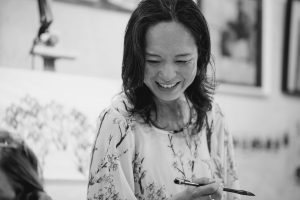
Kaoru Hirose was born in Tokushima, Japan, and is a Sumi-e artist and teacher certified by the International Sumi-e Association in Tokyo. Since 2013 she has taught courses, given demonstrations and held exhibitions in different European cities. You can learn about her career in her biography and see her work on the artworks page.
If you would like to learn Japanese ink painting with guidance:
- In the online Sumi-e classes you work weekly with the teacher live, practising each element separately before bringing it together in a composition.
- In the in-person Sumi-e courses you can observe the gesture up close and receive corrections while you paint.
- For educational institutions, Kaoru teaches courses and masterclasses at universities and art schools.
Frequently asked questions about the ensō
What is the ensō?
The ensō is a circle painted with ink and brush in one or two strokes, without corrections. It comes from the tradition of Zen Buddhism in Japan and is one of the best-known symbols of Zen calligraphy and painting.
What does the Zen circle mean?
The Zen circle is associated with enlightenment, emptiness (mu), the universe and wholeness. It is also considered a reflection of the painter’s state of mind at the moment of painting it.
What is the difference between an open and a closed ensō?
The open ensō leaves a gap between the beginning and the end of the stroke and is associated with movement and the beauty of the incomplete. The closed ensō joins both ends and is associated with completeness and perfection.
How is ensō written in Japanese?
It is written 円相. The first kanji, 円 (en), means circle, and the second, 相 (sō), can be translated as form or appearance.
Is the ensō painted in a single stroke?
It is usually painted in one or two continuous strokes. The important thing is not to stop or retouch the circle after painting it.
What do I need to paint an ensō?
A brush that can hold enough ink, sumi ink, absorbent paper, a felt under the paper, water and a cloth. These are the same basic materials used in Japanese ink painting.
Does the circle have to be perfect?
No. In the ensō, the continuity and sincerity of the gesture are valued more than the regularity of the form. Irregularities and dry areas are part of its character.
Can I paint an ensō without previous experience?
Yes. It is an accessible exercise for beginners, although mastering it takes practice. Starting with long curves and medium-sized circles helps you gain fluency in the gesture.
What is the relationship between the ensō and Sumi-e?
Both are practised with brush, ink and paper, and they share principles such as the gesture without corrections, control of the ink and the importance of empty space. Painting ensō is a good continuity exercise for anyone who practises Sumi-e.